Rethinking Customer Service KPIs: How Putting People First Built a 100% Satisfaction Rate
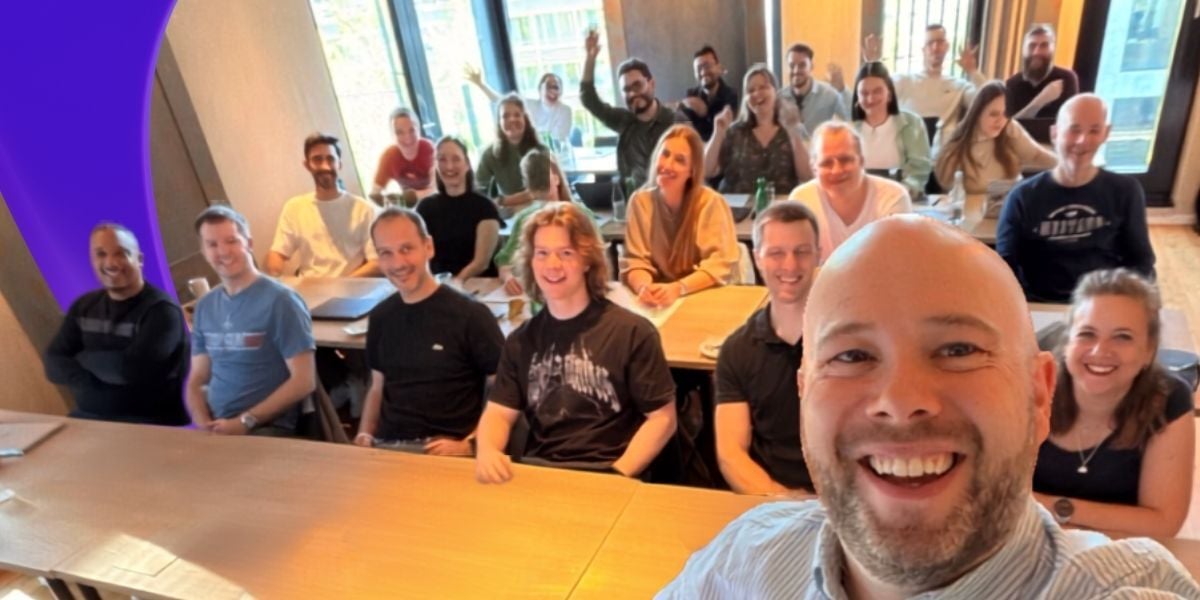
Luware won Silver in the category Best Customer Service at the US Customer Experience Awards 2026, recognizing an approach we call “people over KPIs”. The idea is simple: most customer service teams are measured on speed and volume, but the outcomes customers actually value, a lasting fix and a relationship they trust, come from removing the pressure, not adding to it. Here is what that looks like in practice.
What does “people over KPIs” actually mean?
People over KPIs means measuring the behavior you actually want, and refusing to measure the behavior that quietly works against it. Metrics are not neutral. They shape how people act, often more than any training does. So the first question we ask about any customer service KPI is not "can we track this?” but "what does this number make my team do to a customer?”
Three tensions sit at the center of it:
- Fast resolution is not the same as lasting resolution. A ticket closed in five minutes that reopens next week is not a win.
- Ticket quantity is not the same as relationship quality. You can clear a queue and still lose the customer.
- CSAT scored per agent is not the same as psychological safety. The moment a score threatens someone's standing, they optimize for the score, not the person on the other end.
Why we don't put a clock on resolution
We track first response time and satisfaction, and the one clock we refuse to set is on resolution. To be precise, we do keep response, intervention, and escalation targets. What we reject is a resolution-time SLA. When you put a clock on resolution, agents feel two instincts pull against each other: help this person properly, or close this ticket before the timer turns red. Under pressure, the timer usually wins, and quality is what gets sacrificed.
That does not mean we ignore outcomes. We pay close attention to the metrics that reflect quality of support rather than speed of closure:
- First Contact Resolution (FCR): Did we solve it accurately the first time, with clear communication and an agent empowered to act?
- First Response Time (FRT): How quickly did we acknowledge the person, so uncertainty drops even when the full fix takes longer?
- Time to Resolution (TTR): We watch it as a signal of clear processes, not as a stopwatch to beat.
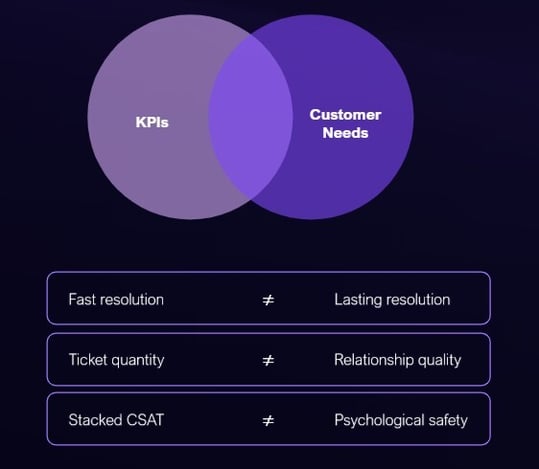 Where KPIs and customer needs diverge: the metrics that look good on a dashboard are not the ones that build lasting relationships.
The difference is subtle but decisive: we let these numbers describe good work; we do not use them to pressure people into rushed work.
The psychology behind it: autonomy, competence, relatedness
Our approach is built on self-determination theory, the research by Edward Deci and Richard Ryan showing that people do their best work when three needs are met: autonomy, competence, and relatedness. People do not thrive on pressure. They thrive on purpose. And most of the time they do not need to be motivated; they need to be unblocked.
In everyday terms:
- Autonomy: room to solve problems creatively, including the freedom to do more than the contract strictly requires when it is the right thing for the customer.
- Competence: a serious onboarding program and continuous shared learning, so people feel genuinely capable.
- Relatedness: peer networks, buddy rotations, daily stand-ups, and one small rule, no work talk on Fridays, because belonging is part of performance.
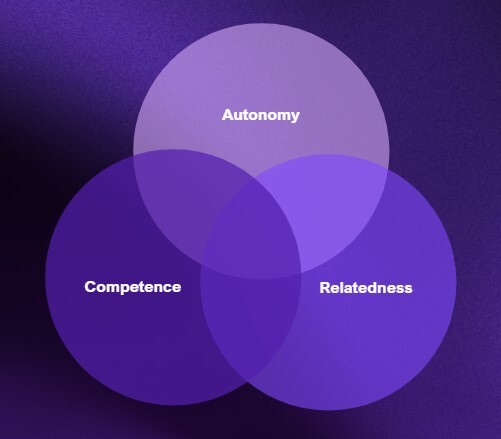 The three needs behind motivation at work: autonomy, competence, and relatedness (Self-Determination Theory, Deci and Ryan).
How we hire for customer service
We flipped what we hire for: the old model was roughly 90% technical skill and 10% soft skill, ours is the reverse. Same job title, close to the opposite hire. When I first took that brief to our recruiters, one of them said, word for word: “This job doesn't even exist. I've hired ten engineers for you. What is this role?”
But I was serious. We stripped the technical must-haves out of our job ads, because every requirement you stack on quietly screens out the very people you want. We started hiring from hospitality, retail, and the performing arts, people whose resumes proved they could read a room and build rapport under pressure. Some of our strongest hires are career changers who came to customer success from an entirely different field, and they bring exactly the instincts the work rewards: sensing what a customer needs, adjusting tone in real time, and turning something complex into plain language they can act on. Here is how I put it to every new hire. You are a performer: you sit on a video call all day, every day, performing to your customers. That ability to connect cannot be taught. Technical skill can.
Our interview has two stages, and the second one surprises people:
- Cultural fit, informal and conversational. Do you naturally connect with people?
- A short PowerShell task, where candidates can use any tool they like, including AI. We do not care whether the script runs. We care whether you can explain it in plain language. It is a communication test, not a coding test.
We have hired candidates who failed the technical part outright and still wowed us with how they explained it.
In SaaS, the relationship is the product
When your product is delivered as a service, the relationship is the product. Years ago the questions we heard were about infrastructure: "how do I configure this server?” Today our DevOps team runs the platform, so the conversation has changed to "how do I get value from this?” That shift matters, because in SaaS revenue is not won once, it is re-earned at every renewal. Renewal depends on the customer succeeding, and success depends on the relationship. That is why our people focus on adoption and success rather than plumbing.
It is also why every customer has one dedicated, named contact, not a chatbot maze and not a different stranger on every call. We segment the team so that ownership matches how each customer needs to be supported, across Customer Success, Enterprise Customer Success, Customer Success Engineering, and Partner Success.
Does it work? The numbers, and the voices
Yes, and the proof is in both the metrics and the retention. Across our customer-facing operation:
- 97% positive support satisfaction
- Average first response in under 27 minutes
- 99.7% of replies inside SLA
- 100% positive onboarding satisfaction
- Renewal rate up 31.8% year over year
Start with that first number, because onboarding is where the relationship begins, and it is where we prove all of this or lose it. Every new customer is surveyed after go-live, and 100% have rated their onboarding positively. That is not an accident: your dedicated Customer Success contact is with you from the first configuration call, not handed over once the contract is signed. Because Luware Nimbus runs inside the Microsoft Teams your team already uses, there is no rip-and-replace and no new interface to learn. We would rather spend an extra hour making sure you can actually run the platform than rush you to a go-live date and meet you again at the first problem.
The number I am proudest of is not on that list, though. Our customer success department has become a talent foundry: because we hire for human skill rather than credentials, we can give people a start who might never otherwise break into this industry, and many have grown from customer success into product management, compliance, and other teams across our 170-person organization. Our leadership is largely homegrown. Sylvia Heiniger, our Head of Customer Success, holds the culture together across European and North American time zones; Jonathan Bassien, our Head of Customer Success Enterprise, runs our nurture-to-renewal program; and René Siegler, our Head of Customer Success Engineering, anchors the technical side. Over the past three years, net attrition on the team has been zero: people leave the team, not the company.
Numbers only tell half the story, though. Here are two customers in their own words.
What this means if you are choosing a contact center
If you are evaluating a CX solution or a native contact center, ask the vendor how they treat their own customers, because that is the service you are buying. Talk to enough teams shopping for a new platform and the same story repeats. The demo looks great, support handles the simple tickets, and then the first real bug or edge case arrives and the help falls flat. You send logs, screenshots, and a careful description, and the person who eventually replies does not know the product well enough to fix it. Add licensing that charges for every small extra, and an admin experience that is hard to learn, and the cheaper option turns expensive fast.
That gap is exactly what people over KPIs is built to close. Because our team is hired for communication, trusted to take the time a problem needs, and empowered to solve it rather than pass it along, the hard cases are where the difference shows.
How is this different from choosing a larger vendor?
A bigger, general-purpose platform can offer enormous breadth, and for some organizations, that is the right call. What you often trade for it is a ticket queue instead of a name, tiered escalation instead of an expert, and a roadmap you cannot influence. With Luware you get a dedicated, named contact, modular licensing so you pay for what you actually use, and a team close enough to the product to act on your feature requests, which is exactly what Credaris pointed to above. Our customer success team feeds structured customer use cases straight into product development, so what you raise actually shapes the roadmap.
Luware Nimbus is Luware's Microsoft Teams-native contact center and CX solution, built on Microsoft's Extend and Unify models so calls stay inside the Microsoft Azure environment your organization already runs. The software matters. But the reason customers stay is that the people behind it are hired, measured, and trusted to care.
We bet you can't teach someone to care. Everything else, we can.