Multi-Platform Compliance Recording in Regulated Industries: What Firms Must Get Right

With most regulated firms running two or three separate recording solutions, they are falling short of audit-ready multi-platform compliance recording, which demands reliable capture, correct retention, and fast retrieval. Each of their solutions is tied to different telephony platforms, archives, and retention configurations. Each has their own interface and search logic. This puts them at risk of undiscovered recording gaps that surface only during audits.
This article draws on decades of implementation experience across financial services to cover how multi-platform compliance recording can be implemented, where fragmented recording setups create risk, and what a certified solution needs to deliver.
What does multi-platform compliance recording mean?
Multi-platform compliance recording is the capture of communications across every platform and modality a regulated firm uses, stored in a unified archive that applies retention rules and produces complete records on demand.
The complexity of doing this consistently across a fragmented communications landscape is greater than it has ever been. Regulated users now communicate across Microsoft Teams, Webex, Zoom, mobile, and trading platforms, and they expect seamless connectivity wherever in the world business takes them. The era of a single on-premise unified communications platform serving the entire firm is well behind us.
What do regulations require for multi-platform compliance recording?
The core recording obligation is consistent across major regulatory frameworks: Capture all relevant business communications, store them for a defined period, and produce them on request. Retention periods and scope vary by jurisdiction.
| Regulation | Region | Recording requirement | Retention period |
| MiFID II (Markets in Financial Instruments Directive II) | EU | Communications that lead to, or are intended to lead to, transactions | 5-7 years |
| DORA (Digital Operational Resilience Act) | EU | ICT-related communications subject to incident reporting and audits | Per ICT risk management policy |
| GDPR (General Data Protection Regulation) | EU | Recording lawful in case of legitimate interest, legal obligation, or consent | Duration of business purpose |
| FINRA (Financial Industry Regulatory Authority) and Dodd-Frank | U.S. | All business communications on any medium used | 3-6 years |
| FINMA (Swiss Financial Market Supervisory Authority) | CH | Provide evidence for client-advisory communications | Up to 10 years |
For a detailed breakdown of the revised MiFID II transposition requirements, see our MiFID III compliance guide. For DORA's implications for third-party communication providers, see this DORA compliance article.
Three things regulated firms must get right about multi-platform compliance recording
Whether a firm records across two platforms or ten, multi-platform audit readiness depends on three requirements: reliable capture, correct retention, and fast retrieval. All three degrade under a fragmented, multi-vendor approach, but they do not fail equally.
Capture: recording everything, every time
The most essential factor in compliance recording is whether the infrastructure covers every channel where regulated communications actually occur. Once a call is not recorded, it is lost. No retention policy applies to a recording that was never created. No retrieval system returns a file that does not exist.
That asymmetry is why capture reliability comes first in any assessment of a compliance recording setup. And in a multi-platform environment, that reliability is harder to guarantee than most firms assume.
More often than not, there is a gap between IT-approved platforms and the platforms employees use. A firm's recording infrastructure is typically built around its official communication stack: the platforms IT procured, deployed, and configured. However, employee communication behavior does not always stay within that perimeter. Client conversations migrate to personal devices. Deals advance over messaging applications that were never flagged under recording policy. A platform introduced during an acquisition brings communication channels that are never connected to the recording infrastructure.
Reliable capture in a multi-platform environment requires a solution that covers the full channel footprint in active use, not just the channels in the IT inventory. The channels that are hardest to see are the ones that produce the most serious exposure: Not only is no single-platform tool configured to capture these communications; a siloed architecture has no mechanism to detect them as missing.
Retention: storing recordings for the required duration
The practical implication of retention requirements in a multi-platform environment is that recordings from different platforms must carry the correct retention rules regardless of where they originated. A recording from a Webex call and a recording from an IPC trading turret that relate to the same transaction share the same retention obligation under MiFID II, for instance.
In a siloed setup, retention rules are configured per system. A policy change applied in one archive but missed in another means recordings from the same obligation end up with different retention treatments. That divergence may not surface until an auditor requests retrieval.
The retention problem is not complexity. It is the multiplication of the human error surface area with every additional system. Unlike a capture failure, a retention failure is recoverable, but only if it is discovered in time.
One of our customers described the reality of this before consolidating onto a single platform:
Retrieval: accessing the right recording when it matters
Retrieval is the moment capture and retention failures surface, because it is where completeness is tested. An auditor requesting a specific communication record expects prompt access to a complete record. A unified search interface that spans all recorded platforms delivers that in one step. A siloed setup requires knowing in advance which system holds the recording, then searching within that system, then confirming whether any related communications exist elsewhere. Under audit conditions, that process is not just slow; it's a finding in itself.
Based on his conversations with compliance professionals at large financial services organizations, Christian Jordan, Global Head of Sales Luware Recording at Luware, has found that this is the norm rather than the exception:
What should compliance professionals look for in a multi-platform compliance recording solution?
A solution that consolidates multi-platform recording needs to meet three requirements to be operationally credible: certified integrations with every platform in use, a genuinely unified archive rather than a shared interface over separate storage systems, and retention policy management that resolves multiple regulatory frameworks automatically.
Platform certifications & integrations
The most important distinction when evaluating vendor claims is between certification and compatibility. A certified, API-level integration is validated by the platform provider for compliance-grade capture. It is capable of handling the full range of platform scenarios such as cross-device calls, remote users, platform-specific encryption, and edge cases that emerge during migrations. Those scenarios were tested and confirmed by the platform provider itself.
A compatible integration may function under standard conditions. It has not been validated for the edge cases that produce recording gaps. When a gap occurs during an audit, general compatibility is not a defensible position with a regulator. For Microsoft Teams, for instance, the specific certification to verify is the M365 Certified Compliance Recording designation. For trading platforms, verify certification directly with the platform provider. Vendor claims of compatibility are not a substitute.
A unified archive for retrieval & audit readiness
A unified interface is not the same as a unified archive, and the distinction matters under audit conditions. A solution that routes recordings from different platforms into separate storage systems and surfaces them through a shared front end reproduces the retrieval problem: It adds a layer on top without solving the underlying structure. Completeness remains unverifiable from a single query.
A genuinely unified archive consolidates recordings at the data layer. The same retention policy engine, the same metadata schema, and the same tamper-proof storage controls apply regardless of the originating platform. One search returns the complete record. Completeness can thus be confirmed.
Scalability across regions & regulatory frameworks
For firms operating across multiple jurisdictions, the recording solution must apply different retention rules to recordings from different regulatory environments automatically. A firm with offices in London, New York, and Zurich, for example, operates under MiFID II, FINRA, and FINMA simultaneously. Retention policy should resolve those requirements at the system level, not through manual configuration each time a new market or regulation applies.
How does Luware Recording cover multiple communication platforms?
Luware Recording, Luware's certified multi-platform compliance recording platform for regulated industries, connects to voice, video, chat, and trading communication platforms a firm uses through certified, API-level integrations. These feed every recording into a single unified archive with consistent retention rules, metadata, and tamper-proof storage controls.
For Microsoft Teams, Luware Recording uses a native, policy-based integration that captures voice calls, video meetings, chat, and screen sharing directly from the Microsoft Cloud via certified APIs. No software installation is required on user devices. This makes capture independent of user location or device, as long as communications take place on the supported platforms.
For Cisco Webex, IPC trading turrets, and 1GLOBAL mobile recording, Luware uses dedicated connector integrations that feed recordings directly into the same archive as Teams interactions. Regardless of the originating platform, recordings are governed centrally and consistently in line with configured retention policies, metadata schema, and storage controls. In practice, this means a compliance officer or auditor can run one query across all platforms, rather than logging into separate systems, applying separate search interfaces, and manually reconciling results.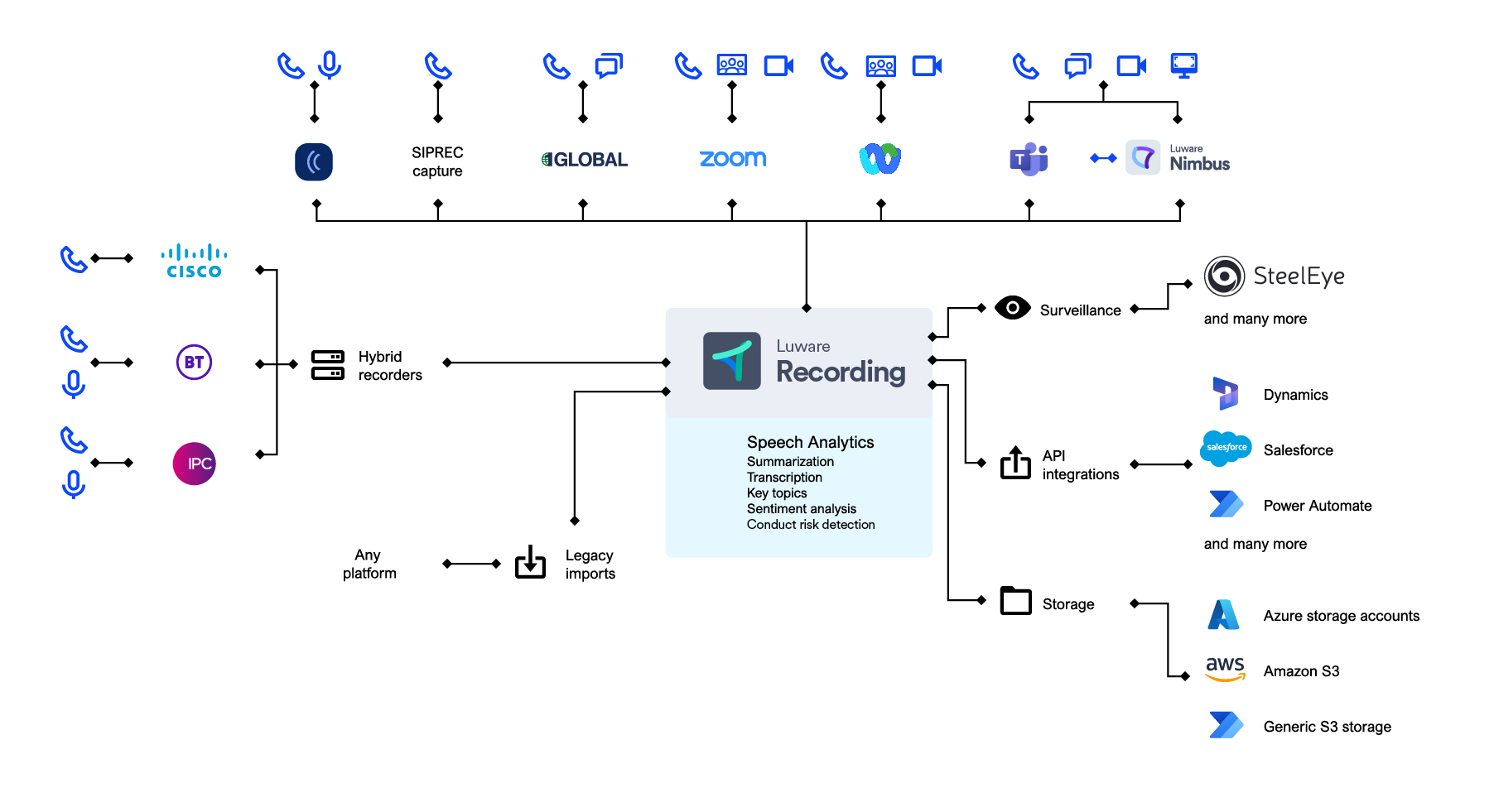
Luware Recording integrations
Luware’s certifications and technology partnerships include:
-
Microsoft 365 Certified Compliance Recording Solution
-
ISO 27001
-
ISO 9001
-
SOC 2 Type II
-
Verint Financial Compliance Partner
What is the first step toward audit-ready multi-platform compliance recording?
The starting point for compliance officers evaluating their current setup is a platform coverage review: a structured comparison of every communication channel in active use against the recording infrastructure in place. If those two lists do not match, the gap between them is the compliance exposure.
If you have not yet established a reliable compliance recording foundation, read this guide to compliance recording risks and value before moving to vendor evaluation.
To see how a global reinsurer moved from fragmented multi-platform recording to a single consolidated solution, read the Swiss Re case study.

More from our Blog

EU AI Act Financial Services Compliance Guide
Learn which AI systems classify as risky, what non-compliance costs, and how firms must manage AI risk to ensure regulatory adherence.