Microsoft Teams has evolved into the central hub for workplace collaboration for millions of organizations. While chat and video meetings are standard, integrating external voice capabilities remains a critical step for many businesses. Leaders often face a difficult choice when adding voice services to this platform. You generally have two primary options to connect your staff to the outside world.
This guide analyzes the differences between Microsoft Calling Plans vs. Direct Routing to help you decide. We will examine costs, infrastructure requirements, and deployment scenarios for businesses. You will gain the knowledge needed to select the right path for your specific telephony needs.
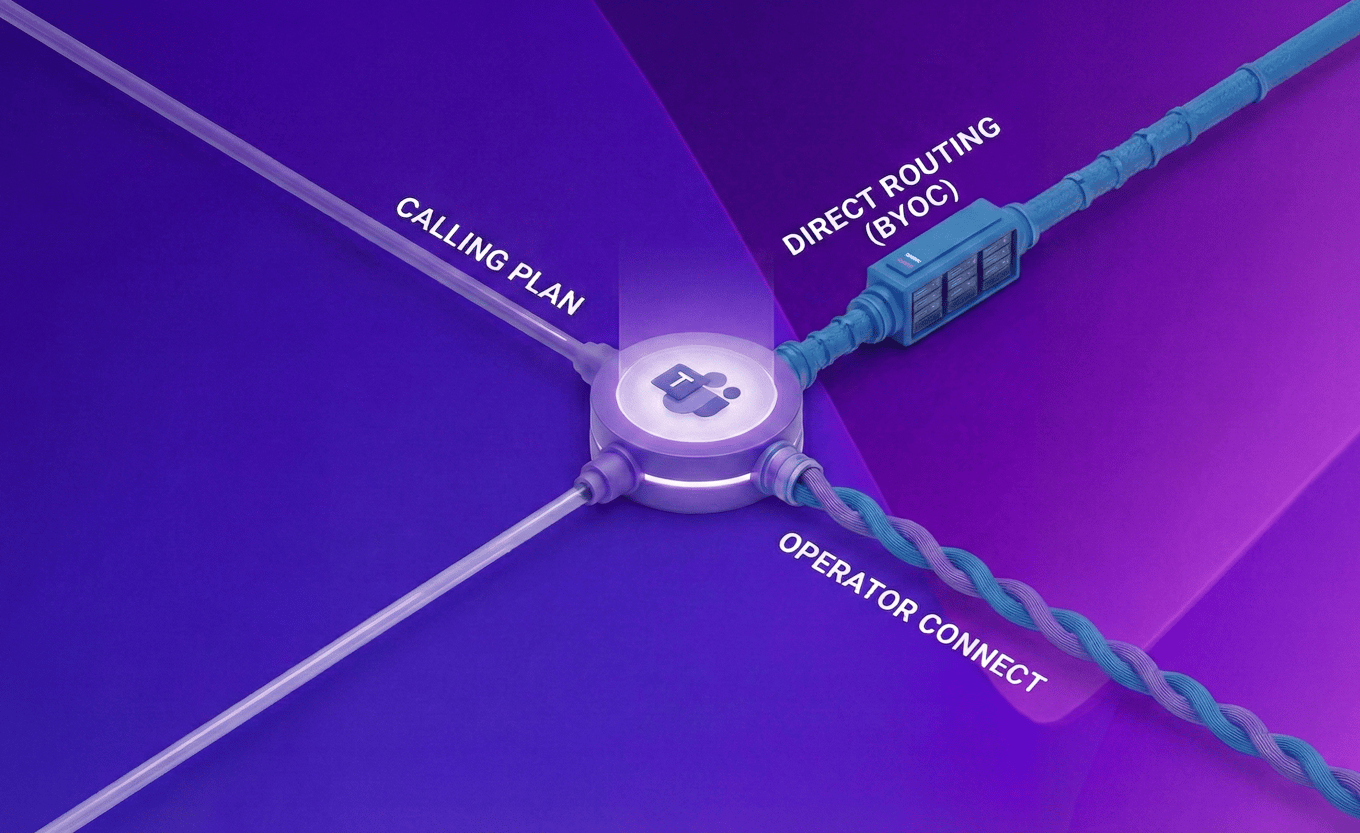
The first option is a standard Microsoft Calling Plan, which functions as a fully managed service. The second is Direct Routing, a flexible method that allows you to retain your current carrier. A third option, Operator Connect, has also emerged to bridge the gap between these two distinct approaches. Making the right choice affects your budget, global coverage, and administrative workload.
What is a Microsoft Calling Plan?
A Microsoft Calling Plan is the simplest way to turn Teams into a business phone system. In this model, Microsoft acts as your PSTN carrier and manages everything in the cloud. You do not need on-premise hardware or contracts with third-party telecom companies to make phone calls.
You simply purchase a license, acquire a phone number, and assign it to a user. The Microsoft Calling Plan includes a bundle of minutes for domestic or international calling. This approach appeals to organizations that want to manage everything within the Teams Admin Center.
Microsoft offers different tiers, such as a domestic Calling Plan or an international one. The setup is incredibly fast because there is no physical equipment to configure. However, this convenience often comes at a higher per-user cost compared to other routing solutions.
Understanding Microsoft Teams Direct Routing
MS Teams Direct Routing allows organisations to connect their own PSTN carrier to Microsoft Teams. This method provides a "Bring Your Own Carrier" (BYOC) model that offers significantly more flexibility than standard plans. You connect your carrier's network to the Microsoft cloud using a Session Border Controller (SBC).
This approach is necessary for companies with complex requirements or those operating in countries where Microsoft does not offer coverage. Direct Routing lets you keep your existing competitive rates and carrier relationships. It also enables integration with legacy analog devices like fax machines or overhead pagers.
How Direct Routing works
To deploy Direct Routing, you must configure a certified SBC between your trunk provider and the Microsoft phone system. The SBC secures the voice traffic and handles the translation between different signaling protocols. This setup allows you to route calls based on least-cost logic or specific geographic rules.
Managing Direct Routing requires more technical expertise than using a Calling Plan. IT teams must manage the SBC infrastructure, although many managed service providers now offer hosted Direct Routing solutions. These hosted options remove the hardware burden while retaining the carrier flexibility.
Key differences: Microsoft Calling Plans vs. Direct Routing
The choice between Microsoft Calling Plans and Direct Routing often comes down to three main factors: coverage, cost, and complexity. Microsoft Calling Plans are limited to specific countries where Microsoft has regulatory approval to act as a carrier. If you have offices in regions like India or China, a Calling Plan may not be available.
Direct Routing solves this problem by delivering true global coverage through local carriers. You can utilize a local carrier in any region and connect them to your Microsoft Teams tenant. This makes Direct Routing the default choice for multinational corporations requiring unified voice services.
Flexibility and features
Direct Routing offers superior flexibility for integrating with third-party applications. Large contact center deployments typically require Direct Routing to maintain specific call flows or CRM integrations. Conversely, Teams Calling Plans are rigid; you get exactly what Microsoft offers out of the box.
When you use Direct Routing, you can also mix and match carriers for redundancy. If one carrier has an outage, your SBC can route calls through a backup provider. A Microsoft Calling Plan leaves you entirely dependent on Microsoft's uptime for your voice services.
Operator Connect: the middle ground
Microsoft introduced Operator Connect to offer a balance between the simplicity of plans and the power of routing. Operator Connect allows you to select a participating carrier directly from the Teams Admin Center. The carrier manages the PSTN connectivity and SBCs, but the experience feels integrated like a native plan.
With Operator Connect, you do not need to manage complex PowerShell scripts or hardware. The service providers handle the technical backend while you assign phone numbers via the Microsoft portal. This creates a fully managed service feel with the pricing benefits of external carriers.
Many businesses are moving to Operator Connect because it simplifies the Teams phone deployment. It provides better support level agreements (SLAs) than a standard Calling Plan because the operators are specialized telecom companies. However, Operator Connect has fewer carrier options than Direct Routing.
Cost analysis and ROI
Cost is frequently the deciding factor when choosing between a Calling Plan and a Direct Routing solution. Microsoft Calling Plans are generally priced per user, per month. This can become expensive for organizations with hundreds or thousands of users. A standard domestic Microsoft Calling Plan might cost $12 to $20 per user, depending on the market.
Direct Routing typically offers significant savings for larger enterprises. Carriers often charge for the SIP trunk paths (concurrent calls) rather than per user. Since not every employee is on the phone simultaneously, you can buy fewer paths than you have users. This aggregation significantly lowers the monthly bill for business telephony.
Hidden costs to consider
While Direct Routing has lower usage rates, you must account for infrastructure costs. If you host your own SBCs, you have maintenance and licensing fees. Managed service providers charge a fee to handle the Direct Routing solutions for you, which bridges the price gap.
Microsoft Calling Plans have zero infrastructure costs, but overage charges for outbound calls can add up. If your users frequently make international calling connections, the add-on minutes from Microsoft are pricey. Direct Routing allows you to negotiate aggressive international rates with your chosen carrier.
Making the right decision for your business
Choosing the correct routing solution requires an audit of your current and future needs. Small businesses with no IT staff should almost always choose a Microsoft Calling Plan. The ability to port phone numbers and start calling in minutes outweighs the higher monthly cost for small teams.
If you require global coverage or have a large user base, Microsoft Teams Direct Routing is the superior choice. It enables you to standardize on Teams Phone while navigating complex local telecom regulations. Direct Routing also allows you to retain contracts with existing carriers to avoid early termination fees.
The hybrid approach
You do not have to choose just one method. Many large organizations use a hybrid model. They might use Direct Routing for their headquarters and a Teams Calling Plan for small satellite offices. You can also mix in Operator Connect for regions where your primary carrier lacks coverage.
This mix-and-match capability is a core strength of Microsoft Teams. A Teams admin can assign different policies to different users within the same tenant. This granular control allows you to optimize costs while guaranteeing every user can make and receive external calls.
Evaluating support needs
Consider who you want to call when things break. With a Calling Plan, your support ticket goes to Microsoft. With Direct Routing, you troubleshoot with your carrier or SBC vendor. Operator Connect providers offer a middle layer of support that is often more responsive than Microsoft directly.
Microsoft Calling Plans are convenient, but Direct Routing offers the control enterprises demand. Operator Connect is rapidly becoming the preferred standard for mid-market companies. By understanding these three pillars—Calling Plans, Direct Routing, and Operator Connect—you can build a robust unified communications strategy.
Ultimately, the "better" option depends on your scale. Startups should lean toward Calling Plans for speed. Enterprises should leverage Direct Routing for power. Mid-sized firms should evaluate Operator Connect for the best balance of both.
Enhancing Teams Telephony with Luware Nimbus
While choosing between a Calling Plan, Direct Routing, or Operator Connect defines how you connect to the phone network, Luware Nimbus defines what you can do with those calls once they reach Microsoft Teams.
The specific connectivity model you choose acts as the “pipe” for your voice traffic. Luware Nimbus sits on top of that infrastructure to transform Teams into a fully functional contact center and enterprise attendant console.
Connectivity Agnostic The biggest advantage of Luware Nimbus is that it is completely topology agnostic. Because Nimbus is a native Teams application, it does not matter which method you use to get the dial tone into your tenant.
-
With Calling Plans: Add sophisticated routing to your simple setup without needing extra hardware.
-
With Direct Routing: Leverage your existing carrier relationships and complex global setups while using Nimbus for customer service workflows.
-
With Operator Connect: Enjoy the managed service feel of Operator Connect while Luware Nimbus handles your complex call distribution and reporting.
Why add Luware Nimbus? Native Teams telephony is excellent for 1:1 calls and simple queues. However, as soon as you require CRM integration, historical reporting, live dashboards, or after-call work for contact center employees, you need a specialized solution. Luware Nimbus bridges this gap, ensuring that no matter which connectivity path you choose (or if you use a hybrid of all three), your customer experience remains seamless and professional.